Postpartum Weight Loss: What I Would Do Differently (And Why It Actually Works Faster)
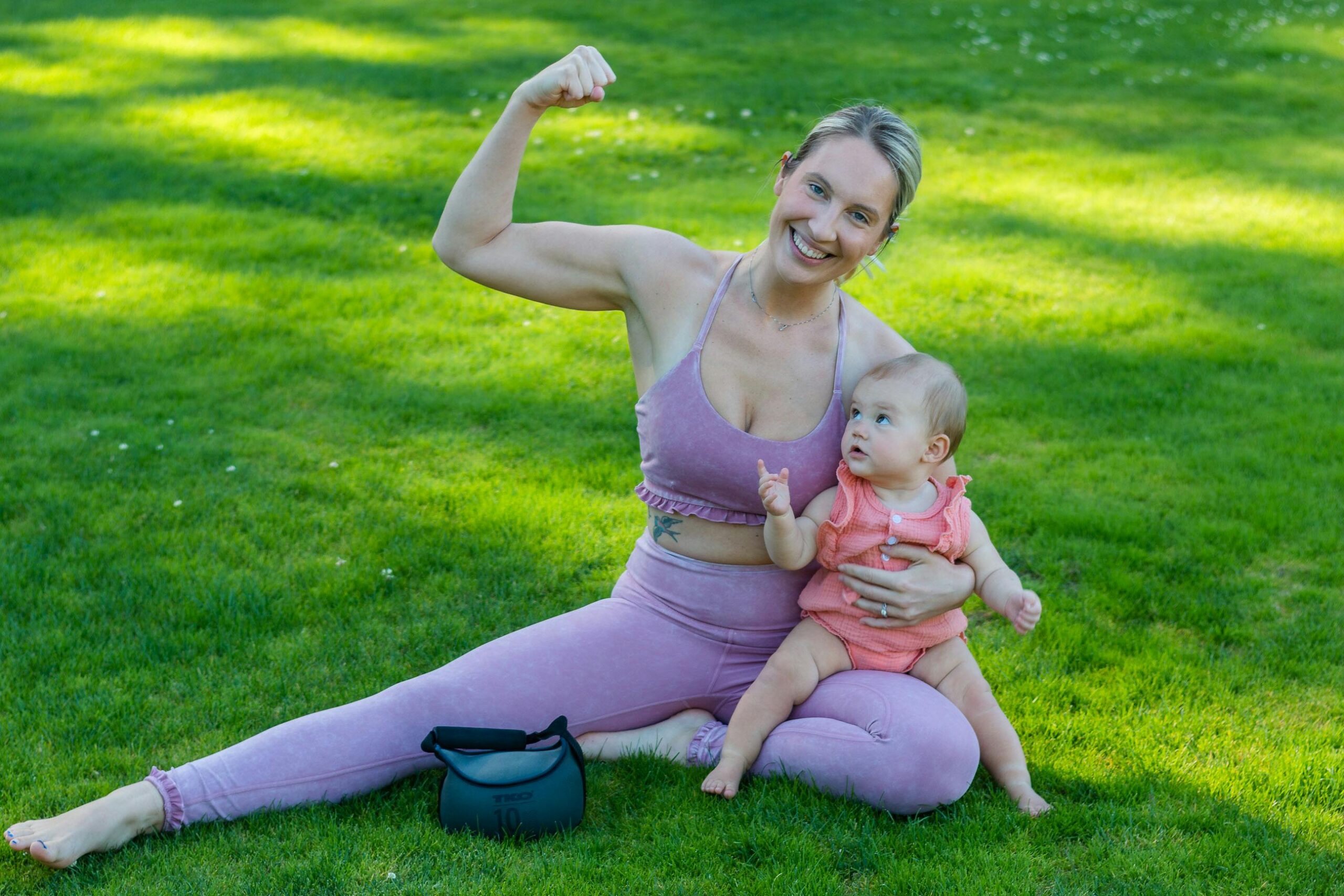
By Leslie Stevens | Registered Dietitian, Wellbeing Nutrition Coaching | 5 min read
Here is something I want you to really sit with. Would you ever come home from major surgery and think, “I need to cut my calories so I can recover faster”? Of course not. You would rest. You would eat good food. You would take care of yourself.
And yet that is almost exactly what most of us do after having a baby. We go through one of the biggest medical events of our entire lives, and within weeks the pressure starts. Lose the baby weight. Bounce back. Get your body back.
But here is what nobody talks about: the goal was never to just bounce back. The goal was to have the feel like yourself again and actually have the energy to actually enjoy this season. To be present with your baby instead of foggy and depleted. To be confident and capable, sooner rather than later.
I have been through this twice myself, and after years of working with new moms as a registered dietitian and personal trainer, I can tell you that the approach to lose weight immediately is almost always the one making everything take longer and feel so much harder than it has to. When you do this the right way, you do not just lose the weight faster. You feel better getting there, and that changes everything about this transition.
Why Restricting Calories Postpartum Backfires
Before we get into what actually works, I want to talk about why the most common approach to postpartum weight loss leaves so many women feeling stuck, exhausted, and like something must be wrong with them. Because there is nothing wrong with you.
Think about what your body just did. It grew a whole person. It went through labor and delivery. And now it is recovering, running on broken sleep, and if you are breastfeeding, it is feeding your baby around the clock. Your body is working harder than it ever has, even when you are sitting on the couch and feel like doing nothing.
When you add cutting calories on top of all of that, you are not helping your body lose fat faster. You are draining the very energy reserves that would let you be present, patient, and functional during one of the most demanding seasons of your life. And a depleted body does not let go of weight. It holds on.
What stress actually does to your body
You are already running on less sleep than you have ever had, keeping a tiny human alive, and adjusting to a version of your life that looks completely different than before. Adding the physical stress of restricting food on top of that does not just stall losing baby weight. It also chips away at the energy and patience you need to actually show up for your baby, your partner, and yourself.
Eating less is not always the answer
Research from 2021 found that new moms are especially likely to hold onto weight when they are not eating enough to support what their bodies actually need right now. When you undereat, your body slows down to match. It is not broken. It is just trying to take care of you.
This is not a willpower problem. It is not a discipline issue. Once you understand that, you can stop fighting yourself and start working with your body instead. And that shift alone is where most of my clients start to feel better even before the weight starts moving.
The women who struggle most with postpartum weight loss are often the ones trying the hardest. They are eating less, pushing through workouts too soon, and running on fumes. The plan failed them. They did not fail the plan.
How to Lose Weight After Baby: 3 Things That Actually Work
When you do this the right way, something really important happens along the way. You start to feel better before you even reach your goal. More energy. More patience. More of yourself showing up in the day. And that feeling is what makes this actually sustainable. Here is how to get there.
1. Feed your body well first, before anything else
The very first step in any real postpartum weight loss plan is not a calorie deficit. It is making sure you are actually eating enough, and that what you are eating is giving your body something to run on.
This matters so much more than most people realize, and not just for weight. When you are running on whatever you can grab between feedings and barely eating real meals, it shows up in ways that go way beyond the scale. The brain fog you push through all day. The short fuse that comes out of nowhere around 4pm. The afternoon wall where you just cannot function anymore. Those are not signs that something is wrong with you. Those are signs that your body needs more fuel, and when you give it that, those things start to lift.
One of the most common things I see is new moms skipping breakfast because mornings are chaos, then crashing by mid-morning and not understanding why they feel so terrible. That crash is not laziness. That is your body running on empty. And when you start eating consistently, something really good happens: you get through your mornings with more energy, you are more patient at dinner time, and you actually have something left in the tank at the end of the day for the people you love.
Here is the thing I come back to over and over: when you take care of your body now, you become a more present, more energized version of yourself during one of the most important seasons of your life. And that same foundation is exactly what makes real, lasting weight loss possible when the time comes.
2. Add in some strength training as soon as you are cleared
When women ask me how to lose the postpartum belly, most are thinking cardio. And while walking and gentle movement are wonderful early on, the research on strength training for new moms is really worth paying attention to.
One study followed 60 postpartum women through 18 weeks of either strength training or flexibility work. The women who did strength training felt significantly more confident in their bodies and saw real improvements in their mood. (Larson-Meyer, 2012) And that confidence is not a small thing. It is the feeling of recognizing yourself again.
Having a baby is one of the biggest physical changes you will ever go through, and it can leave you feeling disconnected from your own body. Strength training is one of the most direct ways to rebuild that relationship. Not by forcing your body back to what it was, but by showing you what it can do right now. You do something hard. You feel yourself get stronger. You start to trust your body again. And that feeling of capability, of being someone who can handle hard things, carries over into everything else in your day.
There is also a practical reason to do it: the more muscle you have, the more your body naturally burns throughout the day, even when you are not doing anything. So when you are ready to lose weight intentionally, your body will be set up to actually cooperate.
3. Let it be messy and keep going anyway
This is honestly the hardest one for the women I work with, because they are not people who half-commit to things. But postpartum weight loss is not a straight line, and the sooner you make peace with that, the faster and more enjoyably things actually move.
There will be days where you do not have time to prep anything. Days where your workout is three sets before the baby wakes up. Days where eating well means grabbing a handful of nuts and a glass of water and calling it a win. Those days are not failure. That is just new motherhood, and it is completely okay.
What matters is the baseline you keep coming back to. Keep easy, filling options around like Greek yogurt, hard boiled eggs, nuts, or a protein bar you actually enjoy. Every time you do something good for your body, even something small, you are building the energy and strength that helps you show up better. A body that is getting something consistently will always come out ahead of one that gets nothing all week and restarts on Monday.
And when things start to feel a little more manageable, when sleep gets slightly more predictable and you find some kind of rhythm, that is when you can step into a real plan. At that point, intentional weight loss actually works, in a shorter window, because you have the energy to do it and the foundation is already there. You are not fighting your body. You are working with it.
How Long Does It Take to Lose Baby Weight?
This is the question I get more than almost any other, and I want to give you a real answer. The timeline matters way less than the approach you take to get there, because the approach determines not just how fast you lose the weight but how you feel while it is happening.
In the first few weeks after delivery, most women naturally lose a good chunk of weight from the baby, the fluid, and everything that comes with birth. What stays after that is weight your body stored during pregnancy, and that responds directly to how well you take care of yourself in this season.
What I see over and over is that the women who spend those first couple of months eating well, moving their bodies gently, and genuinely recovering, they come into the weight loss phase with actual energy. They are sleeping a little better. They feel more like themselves. And when they step into an intentional plan, it works, in a shorter window, because their body is ready and so are they.
The women who jump straight into restriction right after giving birth tend to plateau fast, feel awful, and fall off, not because they lack discipline but because they were running on nothing trying to do something really hard. That was never going to be sustainable.
Give yourself at least the first 8 to 12 weeks to focus on recovering and eating well. Think of it this way: every good thing you do for your body right now is building the energy, strength, and confidence that makes the next phase possible. You are not delaying your goal. You are setting yourself up to actually reach it, and to feel really good when you do.
Postpartum Diet Plan: What to Actually Focus On
A real postpartum diet plan is not about cutting things out. It is about giving your body what it needs to have energy, feel good, and eventually lose the weight in a way that actually lasts. Here is where I focus with every client:
- Protein at every meal — aim for at least 25 to 30 grams per meal to keep you full, support your energy throughout the day, and help your body recover
- Actually eating breakfast — skipping it crashes your energy first thing and sets up a hard day before it even really starts
- Foods with iron — iron gets depleted after having a baby and is one of the biggest hidden reasons behind that bone-deep exhaustion that no amount of sleep seems to touch
- Good fats like avocado, olive oil, nuts, and eggs — these keep you satisfied, support your mood, and help your body actually function the way you need it to
- Convenience that fits your real life — the best postpartum eating plan is one you can actually pull off with a baby on your hip
And here is what I truly believe after doing this work for years: a meal plan runs out, but understanding lasts forever. I do not just hand my clients a list of foods. I teach them to understand what their body needs so they can make confident, calm decisions from their own knowledge. No more second-guessing every meal. No more food noise running in the background. Just clarity. That is what changes the day-to-day experience of being a new mom.
The Real Goal of Postpartum Weight Loss
I want to be honest with you about what I am actually trying to help women achieve, because it is so much bigger than a number on the scale.
The women who come to me are not lazy. They are not undisciplined. They are exhausted and fed up, and they are also missing themselves. They feel foggy and short-fused and like they are just surviving each day instead of actually living it. They are in their heads at every meal, every dinner out, every vacation, doing mental math instead of just being there for the people right in front of them.
Here is what I want you to hear: those things are not just a normal part of having a baby that you have to push through. The impatience, the afternoon crash, the frantic mornings, the fog that will not lift, those are signs that your body is not getting what it needs. And when you give it what it needs, things shift in ways that go way beyond the scale. You have more energy to be present with your baby. You have more patience at the end of a long day. You start to feel like yourself again, confident and capable, and that feeling comes a lot faster than the weight loss does.
Frequently Asked Questions About Postpartum Weight Loss
Is it safe to try to lose weight while breastfeeding?
Yes, but timing matters. Most experts suggest waiting until at least 6 to 8 weeks postpartum, and if you are breastfeeding, until feeding is going well, which is usually around the 2 month mark. Cutting back on calories too soon can affect your milk supply and drain the energy you need to function day to day. Focus on eating well first. Your energy will improve, and your body will be in a much better place to let go of weight when the time is right.
Why am I not losing weight postpartum even though I am eating less?
I hear this so often, and I want you to know it makes complete sense. When you are not eating enough, your body holds on to weight as a way of protecting you. Add in the fact that broken sleep makes it hard to have consistent energy and appetite, and you have a situation where eating more thoughtfully, not eating less, is almost always the real answer. Most of the women I work with start feeling noticeably better within the first couple of weeks of eating more consistently, and the weight starts to follow.
How do I lose the postpartum belly specifically?
Some of what looks like a postpartum belly is not actually fat. Your uterus takes about 6 to 8 weeks to fully shrink back down, and some women also experience abdominal muscle separation from pregnancy, which needs specific exercises to address rather than traditional crunches. For actual fat loss in the midsection, the combination that works best is eating enough protein, building in some strength work as you are able, managing stress as much as you can, and sleeping whenever possible. As your energy builds and your body recovers, your belly will start to respond.
What is a realistic postpartum weight loss timeline?
Most women lose the majority of pregnancy weight within 6 months, with some taking up to a full year, and both are completely normal. The women who tend to get there fastest are also the ones who feel best along the way, because they spent the first couple of months focused on recovery and energy before stepping into a real plan. When you start from a place of feeling good instead of a place of depletion, the weight loss phase is shorter, easier, and so much more sustainable. If you are breastfeeding it adds an extra layer of complexity into the picture and the weight loss process is intentionally longer to allow for adequate milk supply at around .5-1 lb per week.
Do I need to track calories to lose weight after baby?
Not necessarily. For a lot of new moms, tracking calories adds mental load to an already full plate, and honestly, that energy is better spent elsewhere right now. What matters more is learning how to put together meals that actually fill you up, eating consistently enough that you are not swinging between restriction and overdoing it, and giving your body what it needs to feel good and have energy. When you feel good, making good choices gets so much easier. That is the foundation everything else is built on.
Your Next Step: The 5-Day Confident Body Challenge
If this post resonated with you, I want to give you something you can actually do this week. Not a complete overhaul. Not another plan to figure out. Just five days of simple, research-backed habits that are going to help you start feeling better in your body right now.
The 5-Day Confident Body Challenge was built for exactly where you are. Each day you get one focused lesson, one doable action, and the support to actually follow through. No overwhelm. No all-or-nothing. Just small steps that add up to something that feels really different by Day Five.
Here is what is waiting for you inside:
- A daily lesson covering the one thing that matters most for your metabolism that day, and exactly how to apply it
- A daily challenge that builds real proof you can trust yourself again
- A printable habit tracker so you can actually see yourself following through
- 15 plus metabolism-supporting recipes that are fast, high-protein, and genuinely good
Five days from now you could wake up with more energy, feel less foggy getting through your day, and actually start to feel confident in the choices you are making for your body. That is not a far-off goal. That is this time next week.
And the best part? It is only $17.
Join the challenge at wellbeingnutritioncoaching.com/confident-body-challenge
You do not need a big overhaul. You just need a first step that actually feels good. This is it.
Sources
1. Tomiyama, A.J. et al. Low Calorie Dieting Increases Cortisol. Health Psychology, 2010. https://pmc.ncbi.nlm.nih.gov/articles/PMC2895000/
2. Postpartum Metabolism: How Does It Change from Pregnancy and What Are the Potential Implications? PMC/NIGMS, 2021. https://pmc.ncbi.nlm.nih.gov/articles/PMC8216742/
3. Larson-Meyer, D.E. Effect of Resistance Training on Body Composition, Self-Efficacy, Depression, and Activity in Postpartum Women. PubMed, 2012. https://pubmed.ncbi.nlm.nih.gov/22738284/
4. The Influence of Energy Metabolism on Postpartum Weight Retention. American Journal of Clinical Nutrition, 2019.
CATEGORY
5/18/2026

Comments Off on